
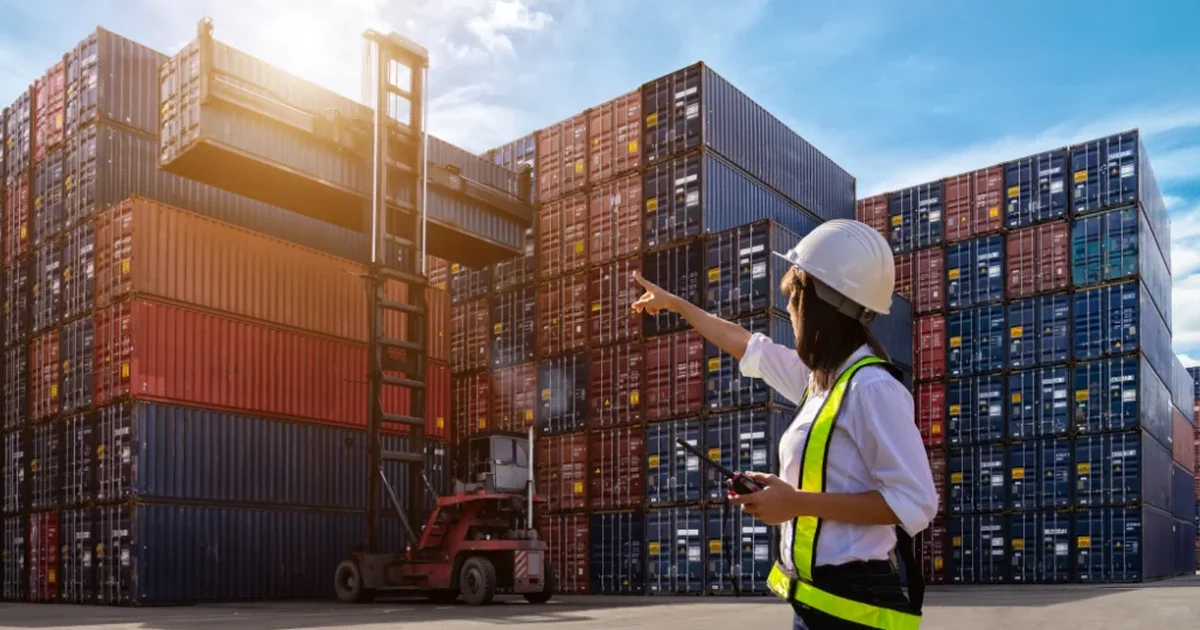
The global logistics software market reached $19.39 billion in 2025 and is projected to grow to $39.66 billion by 2033. The more significant number is the AI subset: the AI in logistics and supply chain management market reached $5.75 billion in 2025 and is growing at 42.2% annually — projected to reach $23.54 billion by 2029. AI-driven predictive analytics for inventory and logistics optimisation have moved from experimental to standard modules in enterprise supply chain platforms.
The gap between the market size and the operational reality is large. Most supply chains still have poor end-to-end visibility. Inventory decisions are made on stale data. Demand forecasts are based on historical averages that do not account for real-time signals. Route planning is done manually or with rules that haven’t been updated in years. The technology to close these gaps exists — the engineering challenge is integrating it into operations that were built long before the data existed.
The Supply Chain Software Stack
Logistics and supply chain management involves five distinct software categories, each solving a different part of the problem. Understanding how they fit together is prerequisite to making good technology decisions.
1. Transportation Management Systems (TMS)
TMS platforms manage the planning, execution, and settlement of freight movements — carrier selection, load tendering, shipment tracking, freight audit and payment. The major platforms: SAP TM, Oracle TMS, MercuryGate, Manhattan Associates. Flexport operates as a tech-forward freight forwarder that bundles TMS functionality with carrier relationships.
The AI layer in modern TMS: carrier rate prediction (ML models trained on historical rate data and market signals predict spot rates, enabling smarter buy/spot mix decisions); dynamic route optimisation (beyond static shortest-path routing — real-time traffic, weather, capacity constraints, and time-window compliance combined with ML); and predictive ETA (replacing carrier-reported ETAs with ML models that account for historical delay patterns by lane, carrier, and season).
Route optimisation impact: AI-powered route optimisation typically reduces fuel consumption by 10–15% and improves on-time delivery rates by 15–20% in production deployments. For a fleet of 100 vehicles driving 200km daily, a 12% fuel saving represents significant annual cost reduction.
2. Warehouse Management Systems (WMS)
WMS platforms manage inventory within warehouse and distribution centre facilities — receiving, putaway, picking, packing, shipping, and returns. Major platforms: Manhattan Active WM, Blue Yonder WMS, SAP Extended Warehouse Management, HighJump, Deposco.
The AI and automation layer in modern WMS:
Slotting optimisation: ML models that determine where in the warehouse each SKU should be stored based on velocity, co-pick frequency, and physical characteristics. Optimal slotting reduces pick path distance by 20–30% — directly reducing pick time per order and labour cost.
Wave planning: optimising when and how pick waves are released to balance workload across pick zones, minimise travel time, and meet shipping cut-off windows. ML-based wave planning improves throughput by 15–25% in high-volume distribution centres.
Robotics integration: autonomous mobile robots (AMRs) from 6 River Systems (Shopify), Locus Robotics, and Fetch Robotics work alongside human pickers, eliminating the time workers spend walking to pick locations. Goods-to-person systems (Autostore, Ocado, Dematic) eliminate walking entirely — robots bring product to stationary pickers. These systems reduce pick labour cost by 50–70% and increase pick accuracy to near-perfect rates.
3. Inventory and Demand Planning
Demand planning software translates signals — historical sales, promotional calendars, seasonality patterns, external market signals — into forward-looking inventory plans: how much of each SKU to order, when, and where to position it.
The traditional approach: time-series forecasting (ARIMA, Holt-Winters) based on historical sales. The limitations: cannot incorporate external signals (competitor promotions, weather, macroeconomic shifts); poorly handles new products with no history; treats all demand as regular when much retail demand is lumpy or promotional.
The AI approach: ensemble models that combine statistical forecasting with ML layers trained on external signals (web search trends, social media, weather, economic indicators), combined with hierarchical forecasting that enforces consistency between national forecasts, regional forecasts, and store-level forecasts.
Measurable outcomes from ML-based demand forecasting: 20–30% reduction in excess inventory; 15–20% reduction in stockout rates; 10–15% reduction in total supply chain cost. The largest impact is typically in seasonal and promotional planning — where traditional methods are weakest.
4. Supply Chain Visibility Platforms
Visibility platforms aggregate real-time data from across the supply chain — carrier tracking events, port congestion, customs status, supplier lead times — into a unified view. The global supply chain visibility software market is growing rapidly, driven by regulatory traceability requirements (the EU Supply Chain Due Diligence Directive, US forced labour import bans) and persistent supply disruption risk.
Key platforms: project44, FourKites, Descartes, Shippeo. These aggregate tracking events from hundreds of carriers via EDI, API, and telematics integrations.
The AI layer: predictive disruption detection. ML models trained on historical patterns identify supply disruptions before they become visible in order status data — a port congestion signal, a carrier capacity crunch, a supplier financial distress indicator — giving supply chain teams time to react rather than respond.
5. Control Tower and Orchestration
The control tower layer sits above the functional systems — TMS, WMS, visibility platform — and provides end-to-end event monitoring, exception alerting, and recommended actions. When a supplier shipment will arrive late, the control tower identifies which downstream orders are affected, calculates the impact, and surfaces recommended responses (expedite alternative supplier, adjust customer delivery commitment, reallocate inventory from another location).
This is where the AI investment is highest and the engineering challenge is greatest. A supply chain control tower requires real-time data integration across every system in the stack, ML models for impact assessment and recommendation generation, and workflow integration that routes alerts to the right decision-maker with the right context.
Integration Architecture for Supply Chain Systems
The most underestimated engineering challenge in supply chain software is not the AI — it is the integration. Supply chain data is distributed across ERP systems, carrier APIs, 3PL portals, supplier systems, IoT devices on trucks and in warehouses, and customs / government data sources. Getting this data into a unified platform requires a serious integration layer.
EDI is not going away. Electronic Data Interchange (EDI) — the 40-year-old standard for B2B document exchange — remains the dominant integration method between large enterprises and their supply chain partners. EDI 850 (Purchase Order), 856 (Advance Ship Notice), 810 (Invoice), and 214 (Transportation Carrier Shipment Status) are the core transactions. Any supply chain platform that needs to work with mid-to-large enterprise customers must handle EDI — either natively or via an EDI gateway (DiCentral, SPS Commerce, TrueCommerce).
API integration for modern carriers and platforms: Shopify, Amazon, and modern fulfilment platforms provide REST APIs. Carrier APIs (FedEx, UPS, DHL, regional carriers) provide tracking and rate-shopping capabilities. Flexport, Freightos, and Freightquote provide freight rate APIs.
Event-driven architecture for real-time visibility: supply chain events (shipment picked up, crossed border, arrived at facility, delivered) need to propagate to all relevant systems in near-real-time. An event-driven architecture (Kafka or cloud messaging — SQS, Azure Service Bus, Pub/Sub) that decouples event producers from consumers is the appropriate pattern. The alternative — each system polling every other system — does not scale and creates inconsistent state across the platform.
Data mesh for analytics: supply chain analytics requires joining data from TMS, WMS, ERP, and visibility platforms — systems that were built independently, have different data models, and are owned by different teams. A data mesh architecture, where each domain publishes clean, curated data products that other domains can consume, is more maintainable than a centralised data warehouse that becomes the responsibility of a central data team who understands none of the source systems.
Last-Mile Delivery: Where the Complexity Lives
Last-mile delivery — the final movement from a distribution centre or store to the end customer — represents 41% of total supply chain cost and is where most customer experience failures occur. It is also the most complex optimisation problem in logistics: hundreds of simultaneous deliveries, dynamic traffic conditions, time window constraints, access restrictions, and real-time order changes.
The algorithmic challenge: vehicle routing problem (VRP) with time windows (VRPTW) is NP-hard — there is no polynomial-time exact solution for real-world instance sizes. Production route optimisation uses metaheuristics (genetic algorithms, simulated annealing, tabu search) or learning-based approaches (pointer networks, attention models trained via reinforcement learning) to find near-optimal solutions within the time constraints of real-time dispatch.
Dynamic re-routing: real-time traffic data (Google Maps Platform, HERE, TomTom) fed into the routing algorithm allows in-progress routes to be reoptimised as conditions change — a traffic incident on a planned route, a customer requesting delivery window change, an undeliverable stop that needs to be rescheduled.
Proof of delivery and exception capture: mobile applications for delivery drivers that capture electronic proof of delivery (signature, photo, barcode scan), report failed delivery attempts, and trigger customer notifications. The data captured feeds back into ML models for delivery time estimation and customer experience analysis.
How we approach this at Insoftex
The route optimisation and real-time data streaming patterns that appear most frequently in logistics software are ones we have built in production. Our delivery efficiency platform implements VRPTW-based route optimisation with dynamic re-routing, integrating live traffic signals into a dispatch system that handles real-time constraint changes — driver availability, delivery window revisions, and failed-delivery rescheduling — without requiring a full route recalculation. The engineering investment in that system was concentrated in the real-time event pipeline, not the optimisation algorithm. A near-optimal routing algorithm producing stale routes is worth less than a simpler algorithm operating on current data.
The real-time e-commerce intelligence platform uses the same event-driven streaming architecture applied to inventory and fulfilment signals rather than route state. The pattern is identical at the infrastructure layer: Kafka-based ingestion, stream processing with stateful aggregation, and a latency-sensitive output layer that drives operational decisions. Logistics software and e-commerce intelligence share architectural DNA because both are fundamentally real-time state management problems with ML inference requirements layered on top.
The make-vs-buy decision at the AI layer is where we focus our engagement scoping. Platform selection (TMS, WMS) is typically straightforward given a team’s scale and operational profile. The differentiation question — which AI capabilities to build custom versus accept from the platform vendor — requires understanding where the client’s logistics operation diverges from the commodity baseline. We scope that divergence in discovery, and the answer determines whether custom optimisation or ML model development is in scope or whether integration engineering alone is the correct investment.
Building or evaluating supply chain software — visibility platform, TMS integration, or warehouse optimisation? Our Product Pilot covers architecture design, integration scope, and AI use case prioritisation in three weeks.
Frequently Asked Questions
What is the difference between a TMS and a WMS?
A Transportation Management System (TMS) manages the movement of goods between facilities — carrier selection, load planning, shipment tendering, freight tracking, and freight payment. It is focused on what happens outside your four walls: how goods move from supplier to warehouse, between facilities, or from warehouse to customer. A Warehouse Management System (WMS) manages operations inside a facility — how inventory is received, stored, picked, packed, and shipped. It is focused on what happens inside your four walls: optimising pick paths, managing bin locations, coordinating dock scheduling, and directing labour. Most mid-to-large logistics operations need both, with integration between them: the TMS knows when an inbound shipment is arriving so the WMS can pre-plan the receiving workflow; the WMS knows when an order is ready to ship so the TMS can tender the outbound freight. The integration point is typically an order management system (OMS) or ERP that sits above both and manages the flow of orders and inventory events between them.
How does AI demand forecasting differ from traditional statistical forecasting?
Traditional statistical forecasting (ARIMA, exponential smoothing, Holt-Winters) extrapolates future demand from historical sales patterns. It works well for stable, regular demand and poorly for promotions, new products, seasonal extremes, and external shocks. AI demand forecasting extends this with three capabilities: (1) External signal integration — ML models incorporate signals that statistical methods cannot: web search trends for a product category, competitor pricing changes, weather forecasts, economic indicators, and social media sentiment. A retailer's demand plan for outdoor furniture can incorporate weather forecasts for the next 60 days; statistical methods use only historical sales. (2) Causal modelling — ML models can learn the causal relationship between promotions and demand lift from historical promotion data, allowing them to generate baseline vs. promotional demand separately. Statistical methods confound promotional lift with baseline demand, degrading forecast accuracy for both. (3) Hierarchical consistency — modern ML forecasting systems enforce mathematical consistency across forecast levels: the national forecast sums to the same number as the sum of regional forecasts, which sum to the same number as store-level forecasts. Statistical methods applied independently at each level produce inconsistent plans that create inventory allocation problems.
What is supply chain visibility and why is it difficult to achieve?
Supply chain visibility is the ability to see — in real time or near-real time — where goods are, what their condition is, and what is likely to happen to them, across the entire supply chain from supplier to end customer. It is difficult to achieve for three reasons: (1) Data fragmentation — supply chain data is distributed across dozens of systems owned by different organisations. A single shipment touches the supplier's ERP, a freight forwarder's TMS, a carrier's tracking system, a customs clearance platform, a 3PL's WMS, and the retailer's ERP. None of these systems were designed to share data with each other; getting a unified view requires integrating all of them. (2) Heterogeneous integration methods — different supply chain partners use different integration methods. Larger partners use EDI; mid-size partners use APIs or web portals; smaller partners send emails and spreadsheets. Achieving visibility across a supply chain means supporting all of these channels simultaneously. (3) Event latency — even when data flows, it often does so in batches rather than in real time. A carrier may update tracking status every 4 hours rather than continuously. The gap between 'where the system says it is' and 'where it actually is' is the gap that disrupts operations. Closing this gap requires a combination of carrier API integration, IoT telematics (GPS on trucks, temperature sensors in containers), and ML-based ETA prediction that can estimate current position from the most recent confirmed event.
What is the make-vs-buy decision for supply chain software?
Supply chain software at the platform level (TMS, WMS, visibility) is almost always buy rather than build. The platforms from Manhattan Associates, Blue Yonder, SAP, and Oracle represent decades of accumulated logistics domain knowledge, carrier and partner network integrations, and regulatory compliance features that would take years and hundreds of millions of dollars to replicate. No engineering team should build a TMS from scratch. The make-vs-buy question becomes relevant at the AI and custom optimisation layer — on top of a commercial platform. Route optimisation algorithms tailored to your specific fleet and constraints; demand forecasting models trained on your specific product mix and customer behaviour; warehouse slotting logic that incorporates your specific physical layout and operational constraints. These are the layers where custom AI development creates competitive differentiation that commercial platforms cannot provide off-the-shelf. The practical decision: buy the platform; build the intelligence layer on top. The integration engineering — connecting the commercial platform to your ERP, your suppliers, your carriers, and your custom AI layer — is typically 50–60% of the total engineering investment.