The Problem
A fast-growing European travel agency specializing in last-minute deals faced a structural content bottleneck. The business model requires filling tour seats quickly — and filling seats requires high-frequency, timely social media promotion. Tours with low capacity remaining, imminent departure dates, and high margin need to be promoted aggressively within a narrow window.
The marketing team could manually produce 5–7 posts per day. The business needed 15–20. The gap was not a creativity problem — it was a throughput problem. And it was costing bookings: last-minute deals launching outside business hours went unpromoted, time-sensitive capacity sat unsold, and no coordination existed between the CRM, the Tour Management System, and the social channels.
The human team was being used as a content factory when they should have been doing strategy.
The Constraints
Brand compliance on every post. The agency had a defined voice, pricing language conventions, and legal disclaimer requirements across channels. Automated content that drifted from brand guidelines or published incorrect pricing would create customer service problems and regulatory risk.
Goal-driven prioritization. Not all tours are equally urgent. A tour departing in 48 hours with 8 seats remaining at high margin needs different prioritization than a tour departing in 3 months with capacity to spare. The system needed to understand business priority, not just content freshness.
24/7 operation without manual triggers. The highest-value publishing windows — last-minute deals, late-night promotions, weekend urgency campaigns — are precisely when no one is at their desk. A system requiring human triggering would miss the most commercially important moments.
Our Approach
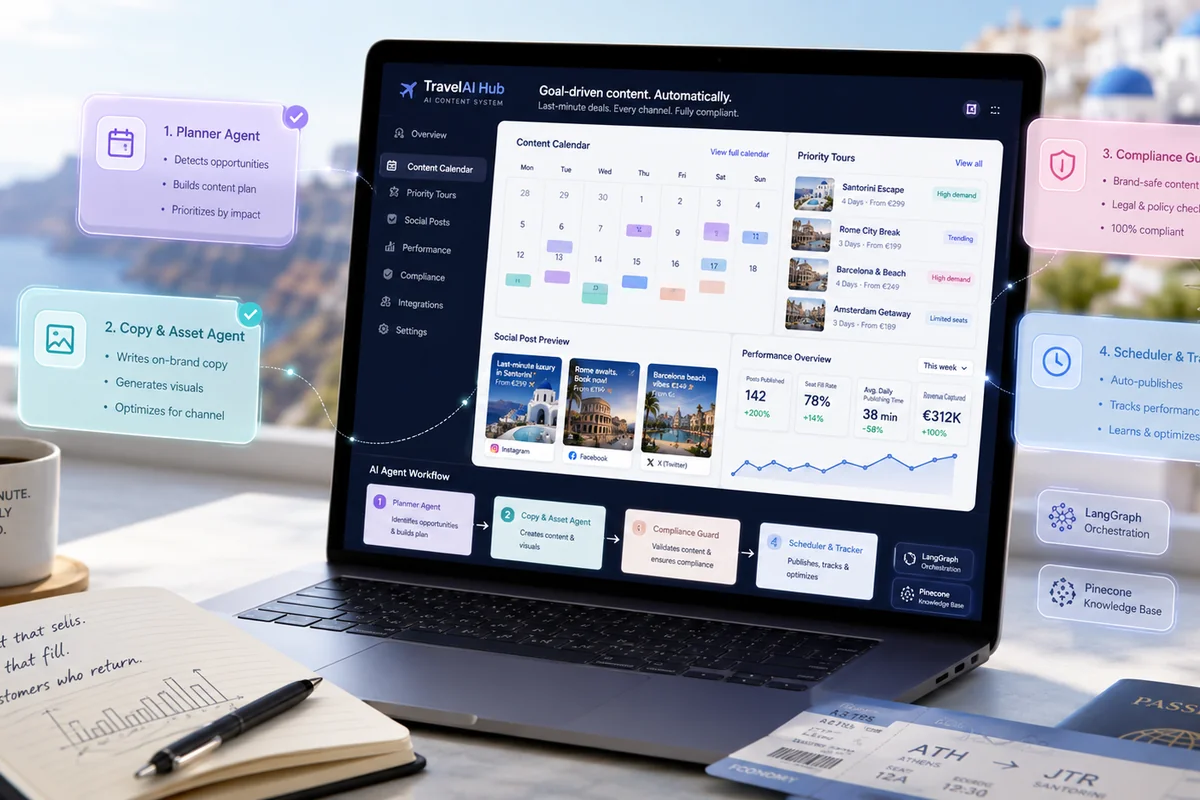
We built a four-agent AI pipeline using LangGraph for workflow orchestration and Pinecone for the semantic knowledge base (product briefs, destination content, historical performance data, brand guidelines).
The Planner Agent runs continuously, ranking tours by a composite Tour Priority Score — weighting time-to-departure, remaining seats, and profit margin. It maintains a rolling 14-day content calendar and flags which tours need promotion in the next publishing cycle.
The Copy & Asset Agent generates channel-specific captions (Instagram, Facebook, X) for each priority tour, drawing on the Pinecone knowledge base for destination-specific facts, local context, and historical engagement patterns. It selects visuals from the asset library matched to the tour type.
The Compliance Guard reviews every piece of generated content against brand voice rules, pricing language standards, and channel-specific disclaimer requirements before it is published. Any post that fails the compliance check is flagged for human review rather than published.
The Scheduler & Tracker publishes through official social APIs with UTM parameters for attribution, logs performance data back to the knowledge base, and triggers the Planner Agent’s next cycle with fresh engagement signals.
The system integrates with the Tour Management System and CRM in read-only mode — taking signals from inventory and booking data without writing to operational systems.

The Outcome
- 200% increase in content output — from 5–7 posts per day to 12–14, without adding headcount
- 14% higher seat fill rate for tours promoted by the AI system compared to manually promoted equivalents
- 58% reduction in daily publishing time for the marketing team, freeing them for creative strategy, partner relationships, and campaign planning
- 100% capture of time-sensitive revenue — overnight and weekend deals now promoted automatically with no missed windows
Team
Engagement: 3 months, 3 engineers (1 AI/ML, 1 backend, 1 integrations).
Stack: LangGraph, Pinecone, OpenAI API, Python, FastAPI, MCP Servers, Instagram/Facebook/X APIs