The Problem
A commercial fleet operator running 800+ vehicles across multiple markets needed real-time visibility into where their vehicles were, how they were being driven, and what faults were developing — without relying on proprietary telematics hardware locked to a single vendor’s platform.
The existing setup was fragmented: GPS data came from one vendor, engine data from a separate OBD-II dongle system, and driver timesheets from paper forms. Dispatchers worked from a map that was 5–10 minutes stale. Incident investigations required pulling data from three separate systems and reconciling timestamps manually. The operator also wanted a mobile application their drivers could use for route guidance, shift management, and exception reporting — replacing the mixed bag of consumer navigation apps in use.
The Constraints
Multi-make, multi-year vehicle fleet. CAN bus data structures differ between makes, model years, and even trim levels. The platform needed an ingestion layer that could normalize engine data (RPM, fuel consumption, coolant temperature, fault codes) across 5 vehicle makes without requiring per-vehicle manual configuration.
Low-latency location tracking at fleet scale. Dispatchers expected to see vehicle positions update in under 3 seconds. At 800 vehicles reporting every 2 seconds, that means the ingest pipeline must handle roughly 24,000 position updates per minute with no perceptible lag in the dispatch view.
Driver behavior analytics without driver pushback. The operator wanted driving behavior scoring — harsh braking, acceleration, cornering, and excessive idling — but needed the scoring to be transparent, explainable to drivers, and tied clearly to safety outcomes rather than surveillance for its own sake.
Offline-capable mobile cockpit. Drivers operating in areas with intermittent connectivity needed route guidance, shift information, and exception reporting to function offline and sync when connectivity restored.
Our Approach
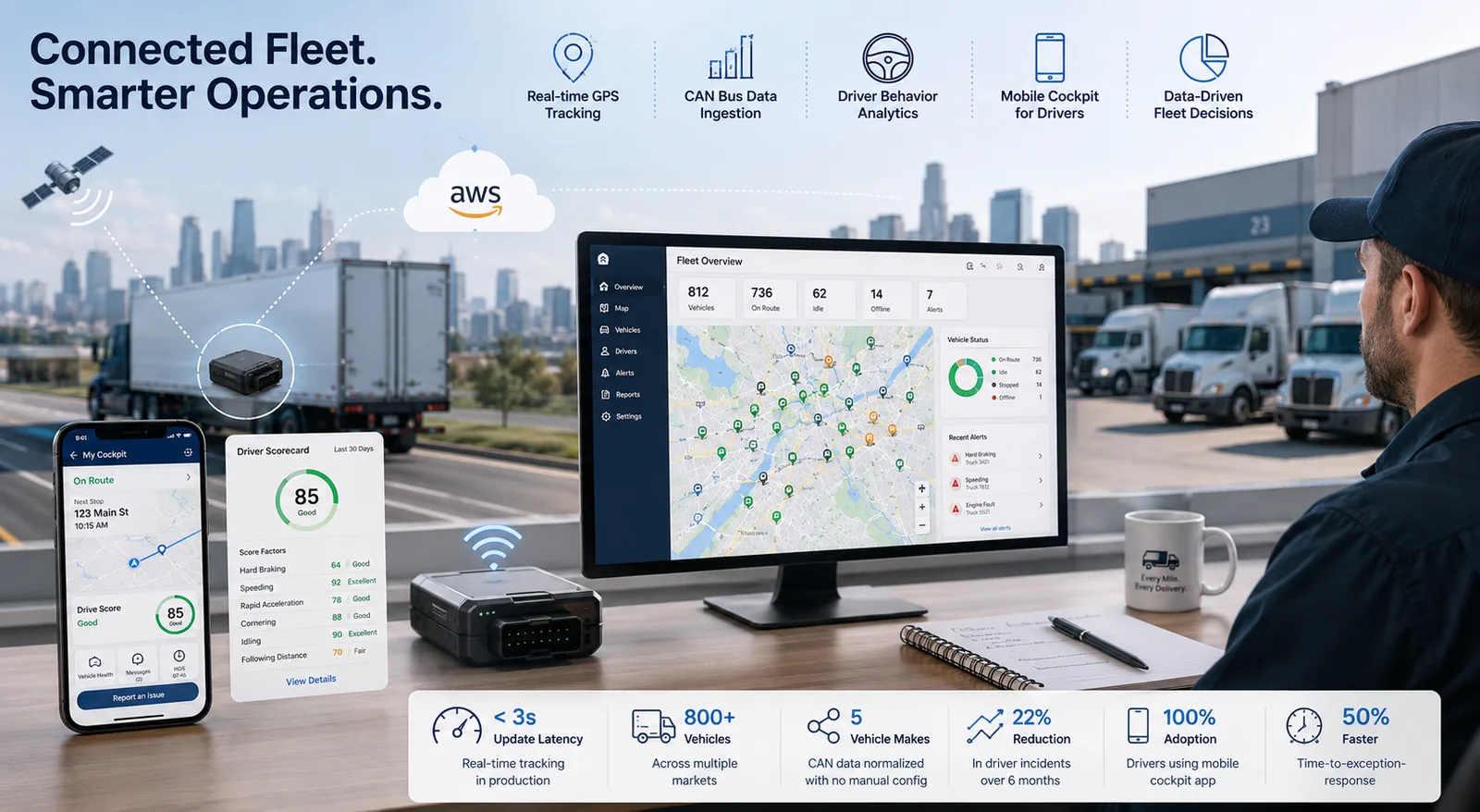
The telemetry ingestion pipeline runs on AWS with a lightweight cellular gateway module in each vehicle that transmits GPS position, speed, heading, and CAN bus data over MQTT at 2-second intervals. The normalization layer maps OEM-specific CAN PIDs to a common internal schema — a PostgreSQL table per data domain (position, engine state, driver inputs) with TimescaleDB extensions for time-series query performance.
The dispatch dashboard is a React application backed by a GraphQL subscriptions API that pushes position and status updates to connected clients as they arrive. The map renders 800+ live vehicle positions with minimal client-side overhead; clustering handles dense urban depot scenarios.
The driver behavior scoring engine runs as a batch process over 30-minute rolling windows, computing scores for 6 driving behavior dimensions using threshold models tuned to the operator’s vehicle mix. Scores are visible to drivers via the mobile cockpit and to fleet managers via the dispatch dashboard — with the specific events that contributed to each score surfaced inline.
The mobile cockpit application (React Native, iOS and Android) provides drivers with turn-by-turn route guidance (Mapbox), shift schedule, vehicle health indicators, and exception reporting (breakdowns, delays, delivery notes). Offline mode caches the current route and shift data locally; position tracking continues via the gateway module regardless of app connectivity.
The Outcome
- Real-time tracking of 800+ vehicles with under 3-second update latency in production
- CAN data normalized across 5 vehicle makes — no manual per-vehicle configuration after initial make/model registration
- 22% reduction in driver incident rate over 6 months, attributed to the behavior scoring program and monthly driver review conversations
- 100% driver adoption of the mobile cockpit app — replacing consumer navigation apps and paper timesheets
- Dispatch efficiency improved — shift managers report average time-to-exception-response dropped by half
Team
Engagement: 7 months, 5 engineers (1 backend, 1 data/IoT, 1 frontend, 1 mobile, 1 platform).
Stack: Python, Node.js, MQTT, AWS (IoT Core, RDS + TimescaleDB, Lambda, S3), PostgreSQL, GraphQL (Apollo), React, React Native (iOS/Android), Mapbox, Docker, Kubernetes