
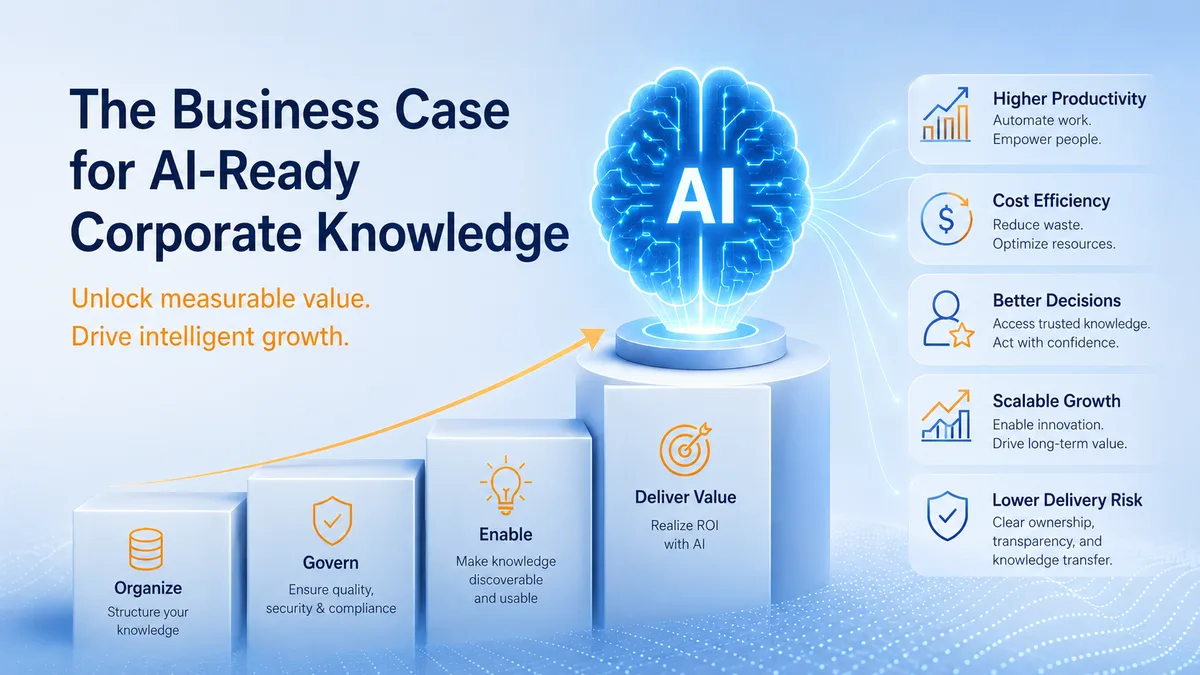
Every established company is sitting on an asset it can’t use. Years of contracts, research, support history, proposals, and hard-won expertise — scattered across drives, inboxes, a CRM, a wiki, and folders nobody has opened since 2022. Leadership knows there’s value trapped in there. They also know that the moment they point an AI tool at it, the demo will impress and the rollout will stall.
This article is the business case for fixing that — and an honest account of the costs, the returns, and the reasons most companies fail to capture them. The numbers are illustrative figures for a typical mid-market company, not a quote. But they’re realistic, and they’re enough to make the decision with your eyes open. If you want the engineering side of the same picture, the reference architecture and the solution overview cover how it’s actually built.
The problem, in money
Knowledge that isn’t organized has a running cost, and it’s larger than most leaders assume. McKinsey Global Institute research found that knowledge workers spend close to a fifth of the workweek — roughly one full day — just looking for internal information and tracking down the colleague who has it. That cost doesn’t appear on any budget line, which is exactly why it’s tolerated for years.
The symptoms are familiar: the same question gets three different answers depending on who you ask; critical knowledge lives in one person’s head or one person’s inbox; nobody trusts the search box, so everyone quietly recreates work that already exists; and a new hire takes months to become productive because the company’s knowledge was never written down in a form anyone — human or machine — can retrieve.
An AI-ready knowledge base attacks this directly. Instead of hunting, your people ask a question and get a current, sourced answer in seconds. The same foundation then powers everything downstream: a support assistant, a sales-enablement copilot, a website assistant, automated workflows. Solve the knowledge layer once, and every AI initiative after it gets faster and cheaper.
The opportunity is real — the evidence is good
This isn’t speculative. A large 2025 study published in the Quarterly Journal of Economics, tracking over 5,000 customer-support agents using an AI assistant grounded in company knowledge, measured a 14% average increase in issues resolved per hour — and a 34% jump for newer, less-experienced staff. The technology compresses the gap between your best people and everyone else by giving everyone access to what the best people already know.
On returns, IDC’s 2024 study of business leaders reported an average of roughly $3.70 back for every $1 invested in generative AI, with most organizations seeing value inside about a year. Deloitte’s late-2024 enterprise survey found that around three-quarters of companies said their most advanced generative-AI initiative was meeting or beating ROI expectations.
So the upside is documented. Here’s the part most vendors leave out.
Most of these projects fail — and not for the reason you’d guess
In 2024 Gartner predicted that at least 30% of generative-AI projects would be abandoned after the proof-of-concept stage by the end of 2025. A 2025 MIT report went further, finding that the large majority of enterprise generative-AI pilots produced no measurable impact on the bottom line. The same report noted that bought solutions succeeded far more often than internal build-it-yourself attempts.
The failures are almost never about the model. They’re about data quality, workflows that were never redesigned, weak integration into daily work, unclear ownership, and governance bolted on too late. Surveys of data leaders consistently rank data readiness and data quality as the top obstacles — not algorithms, not compute. Translation: the project succeeds or fails on the unglamorous work of cleaning, structuring, and governing your knowledge — the exact work that’s easiest to under-scope. It is the same pattern we see in why AI projects fail after the PoC.
This is the hesitation worth taking seriously. It’s also entirely manageable, because the failure modes are known in advance.
Evaluating the alternatives
There are five realistic options. They are not equal.
| Option | What it is | Pros | Cons |
|---|---|---|---|
| Do nothing | Keep searching manually | No spend | The ~20%-of-time search cost compounds; competitors who fix it pull ahead |
| Public AI chatbot | Staff paste into a general-purpose LLM | Cheap, instant | No access to your data; invents answers; a real data-leakage and compliance risk |
| Buy a platform | Off-the-shelf enterprise search | Fast to switch on; vendor-supported | Per-seat economics get expensive at scale (commonly $50K–$450K+/year); limited customization; your knowledge lives in their system |
| Build it yourself | Internal team assembles open-source components | Full control and data sovereignty; no per-seat fees | Highest execution risk; most internal builds stall; needs scarce specialist skills |
| Partner-led build | A specialist builds it with you, then hands it over | De-risked delivery; tailored to your data and compliance; you own the result | Requires choosing the right partner |
The honest read of the market data: buying a platform succeeds more often than an unsupported internal build, but platform pricing punishes you as you grow and locks your knowledge inside someone else’s product. A partner-led build aims to capture the success rate of “buy” with the ownership and economics of “build” — provided it’s scoped and governed properly.
What it costs — a typical mid-market case
Take an illustrative company: around 300 employees, roughly 120 of them knowledge workers in support, sales, operations, and analysis. They want an AI knowledge base spanning their document stores, CRM, support history, and website content, built in phases.
Implementation (one-time). A scoped pilot on one high-value use case runs in the region of $25,000–$35,000 over six to eight weeks. Hardening it into production — multiple sources, hybrid search, role-based access tied to your single sign-on, audit logging, and quality evaluation — brings the total build to roughly $70,000–$90,000. Simpler single-source builds can land under $40,000; heavily regulated or on-premise builds run higher.
Maintenance and run cost (ongoing). Managed databases, the vector store, model and embedding usage, monitoring, and light ongoing engineering land around $3,000/month. Add budget for new sources, periodic re-indexing, and governance reviews, and steady-state cost is about $55,000/year.
A note on the components everyone worries about: the AI tokens are the cheap part. The language-model and embedding usage for a system this size typically runs in the low hundreds of dollars a month, and those prices keep falling. The money goes to data preparation, integrations, access control, and people — not to the model.
| Cost line | Illustrative figure |
|---|---|
| Phase 1 pilot (6–8 weeks) | $25,000–$35,000 |
| Full production build | $70,000–$90,000 (incl. pilot) |
| Run + maintenance | ~$55,000/year |
| Three-year total cost of ownership | ~$230,000–$250,000 |
The hidden costs — budget for them up front. Data cleaning and preparation routinely consumes 30–50% of the project; RAG builds commonly run two to three times their first estimate when this is under-scoped. Compliance (GDPR, HIPAA, data residency) can add as much as the core build if it surfaces late. The way to avoid the overrun isn’t optimism — it’s putting these in the plan from day one and carrying a contingency.
Want this costed for your actual systems? Our Product Pilot audits your sources, data quality, and first use case, then returns a phased plan with realistic build and run estimates — written by the engineers who would build it. Fixed scope, senior engineers from day one.
→ Book a Product Pilot
What it returns
Returns depend on one variable above all others: adoption. Here is a deliberately conservative model for the same company.
| Assumption | Value |
|---|---|
| Active users (of 120 knowledge workers) | 80 |
| Time recovered per active user | 2 hours/week |
| Working weeks per year | 46 |
| Fully-loaded cost per knowledge worker | |
| Annual value created | ~$250,000 |
Two hours a week is conservative against research showing knowledge workers lose closer to a day a week searching, and against measured productivity gains of 14% and up. Even so, the model returns roughly $250,000 a year against a ~$55,000 annual run cost, and pays back the ~$80,000 build inside the first year. That’s consistent with the 6-to-12-month payback most credible studies report.
The honest sensitivity analysis is the important part. Recover only half the assumed time, and the system still returns several times its cost. Recover none of it — the failure case — and you’ve spent $80,000 on an impressive demo. The technology cost is not what determines the outcome. Adoption and data quality are. Which is precisely why the build matters less than how it’s run.
Short, medium, and long term
Short term (first quarter). A pilot proves value on one painful, high-traffic use case. People stop hunting for a handful of answers they need daily, and you have evidence — real usage, real time saved — before committing to scale.
Medium term (year one). More sources come online, more teams adopt it, and the value compounds. The same knowledge layer starts powering a second and third use case — a customer-facing assistant, an internal copilot, an automation — each at a fraction of the original cost, because the expensive foundation is already built.
Long term (years two to three). The knowledge base becomes a durable, appreciating asset. It’s where institutional memory now lives in a form both people and machines can use; it survives staff turnover; and it’s the foundation every future AI initiative plugs into. Organized knowledge stops being overhead and becomes a quiet competitive advantage that’s genuinely hard for competitors to copy.
The decision path
You don’t decide this in one go. You stage it, with a clear test at each gate.
Gate 1 — Is the problem worth it? Estimate the time your teams lose to finding information and recreating work. If it’s a meaningful fraction of payroll — and for most established companies it is — proceed.
Gate 2 — Run a scoped pilot. Pick one high-value use case on your cleanest, highest-traffic content. Define success up front: time-to-answer, accuracy, adoption. Spend pilot money, not platform money. Proceed only if the pilot shows real usage and a measurable lift.
Gate 3 — Harden and broaden. Add sources, access control, governance, and evaluation. Budget data cleaning honestly and carry a contingency. Scale only if retrieval quality holds against a real test set and adoption is growing. If the blocker is data quality, fix the data before adding scope — don’t paper over it with a bigger model.
Gate 4 — Scale or buy. Re-test build-versus-buy at your real user count. Keep building if you’re capturing value and own the economics; consider a platform only if the full, all-in total cost of ownership genuinely beats your run cost.
The single most important rule sits underneath all four gates: assign a senior business owner, redesign the workflow rather than bolting AI onto it, and tie every metric to a concrete outcome. That — not model selection — is what separates the small minority of projects that deliver from the majority that don’t.
How we approach it
We build AI-ready knowledge systems for funded SaaS teams and regulated mid-market companies, and we’ve watched enough projects stall to know the failure isn’t technical. So we work the way the evidence says you should.
We start small and prove value on real data before anyone commits to a platform-scale spend. We treat data quality as the project, not a prerequisite — the cleaning, structuring, and governance that most teams under-scope is where we spend our effort. We design for your compliance regime from day one — residency, access control, audit trails, regulated-data handling — because retrofitting it is what blows budgets. We keep humans in the loop, so AI proposes and your people approve; trusted knowledge is promoted deliberately, never silently overwritten. And we hand you something you own — a system tailored to your data and your business, vendor-neutral by design, with no per-seat lock-in and no dependence on us to run it.
The reason most companies hesitate isn’t a lack of tools. It’s the risk of choosing wrong, the fear of a project that balloons, and the gap between a slick demo and a system that survives a security review. Closing that gap is the work.
Frequently Asked Questions
What does an AI-ready knowledge base actually cost for a mid-market company?
As an illustrative range for a ~300-person company: a scoped pilot on one use case runs around $25,000–$35,000; a full production build with multiple sources, access control, and evaluation reaches roughly $70,000–$90,000; ongoing run and maintenance is about $55,000/year. That puts three-year total cost of ownership near $230,000–$250,000. These are illustrative figures, not a quote — actual cost depends on data quality, number of systems, and compliance scope.
Where does the ROI actually come from?
Mostly from time recovered. Knowledge workers lose close to a day a week searching for internal information; recovering even two hours per week across 80 active users at a fully-loaded rate returns roughly $250,000/year against a ~$55,000 run cost — a payback inside the first year. Additional value comes from faster onboarding, faster proposal preparation, and reduced support load. The single biggest variable is adoption.
Isn't the AI model the expensive part?
No — it's usually the cheap part. Language-model and embedding usage for a mid-market system typically runs in the low hundreds of dollars a month, and prices keep falling. The budget goes to data cleaning, integrations, access control, governance, evaluation, and people. Projects that assume the model is the cost — and under-scope the data work — are the ones that overrun two to three times.
Should we buy a platform or build a custom system?
Market data shows bought platforms succeed more often than unsupported internal builds, but per-seat platform pricing gets expensive as you grow and locks your knowledge inside someone else's product. A partner-led custom build aims for the success rate of buying with the ownership and economics of building. Re-test the decision at your real user count once a pilot has proven value — don't commit to platform pricing before you have evidence.
How do we avoid being one of the projects that fails?
Stage the investment behind decision gates, assign a senior business owner with authority, redesign the workflow instead of bolting AI onto it, and budget the data-cleaning work honestly with a contingency. Start with one painful, high-traffic use case on clean content, define success up front, and scale only when retrieval quality holds and adoption is growing. The failures are organizational, not technical — and they're predictable enough to design around.